

Ministry of Labour and Small Enterprises Development (Molsed) in collaboration with the Occupational Safety and Health Authority and Agency
Aim: Consultation to amend the OSHA act
Location: Radisson Hotel, POS
TTRNA representative: President - Idi Stuart
Date: March 21st - 22nd 2017
Day 1
Opening remarks were made by Mr. Dalkeith Ali (Acting Permanent Secretary of Molsed), and Mrs. D. Walter (Deputy Director of ILO). Dr. Victor Coombs (Chairman of OSHA) gave an update of challenges and successes of the agency thus far. He also spoke of the estimated 800 accidents in Trinidad and Tobago, all of which remained unreported to the Agency. Since inception of the OSHA regulations in Trinidad and Tobago to date, its regulations have never been updated. Internationally, however countries such as Canada, USA and UK have revisited their regulations 23, 17 and 20 times respectively.
In working group sessions, discussions were held and the following areas identified as requiring change or review:
1. The structure of the Authority and Agency under the Act;
2. Review the powers of inspectors under the Act;
3. Updating the list of Occupational diseases;
4. The prosecution of occupational safety and health offences;
5. Review and updating of fines;
6. Consideration for the inclusion of workplace related stress within the Act;
7. Medical inspectors required under the Act;
8. Updating of definitions;
9. Amending subsidiary legislation;
10. Certificates required under the Act;
11. Updating of forms under the Act;
12. Notices issued under Section 74;
13. Notification and investigation of accidents and occupational diseases;
14. Limitation periods of enforcement proceedings
TTRNA supports JTUM's twenty-eight (28) points’ recommendations to the consultation including and not limited to:
Recommendation: Persons employed in HEALTH and laboratory services together with the Fire and Prisons Services are currently enlisted under a category of employees debarred from 'their right to refuse work' in situations where working environment/conditions are deemed unsafe.
Day 2
A panel discussion was held, led by Mr. Vincent Cabrera (JTUM), Dr, Thackwrary Driver (Joint Chambers) and Mr. Farzan Ali (ECA).
Comrade Cabrera spoke about the genesis of OSHA and the introduction and proclaimation of OSHA as it replaced the Factories Ordinance. He spoke on the removal of healthcare workers, prison officers, fire officers and laboratory workers from the categories of workers who are denied "the right to refuse work" due to health and safety issues.
Reccomendation: There must be a repeal and review of the Workman’s Compensation Act to go hand in hand with the OSHA Act.
Dr. Driver expounded on reasons why Norwegia is considered the happiest place on earth. The Trinidad Guardian newspaper dated March 21st 2017 was referenced, in an article which stated; that it was the country's functional institutions which made citizens more comfortable with the services being provided.
Dr. Driver reiterated the need to place emphasis on the implementation of the components of the OSHA Act. According to him, it was imperative that safety be included as part of the basic training within job standards and be reflected by certification of training. He identified that the safety process may have been overlooked by the legislation.
Companies which have good safety systems, also show a corelation with good quality and corporate governance systems. This is also evidence in the company's profitability.
He also spoke on, the role of union in stymying safety procedures (drug testing) and the right to refuse to work due to unsafe conditions, which needs to be revisited.
Mr Farzan Ali expressed the significance of cultural change as it relates to the OSHA act and not merely on the legislative disparity. He went on to highlight the Government as one of the major violators of the OSHA law. Despite the volume of work that has been done in the production of the OSHA act, there is a lack of regulation inherent within the ACT. Questions arose on the ability of state agencies to work together.
He also revealed the importance of the OSHA agency as reflected by the board being designated as a C Board (one of the least monetary assignation).
Noteworthy of mention was the 'right to refuse to work' which has been abused instead of being afforded to essential persons within reasonable limitations. Although it is a costly venture when there are accidents in the workplace. The ECA supports an OSHA agency that assists them in safe work practices
As a result OSHA has taken preliminary steps towards the creation and update of the following regulation:
1. LOLER
2. PUWER
3. Safety of pressure system
4. Electricity at work regulations
5. Ionizing radiations regulations
6. Reporting of injuries, disease & dangerous occurrences regulations (RIDDOR)
7. Safety committees & safety representative regulations
8. Workplace safety, health & welfare regulation (applies to nursing)
9. Construction, design & management regulations
10. Contractor safety management
11. Control of substances hazardous to health (COSHH)
12. Working at height
13. Control of industrial major accident & hazard regulations
14. Display screen equipment.
TTRNA will continue to share information and provide feedback to all our valuable members.
Submitted By:
Publications Committee
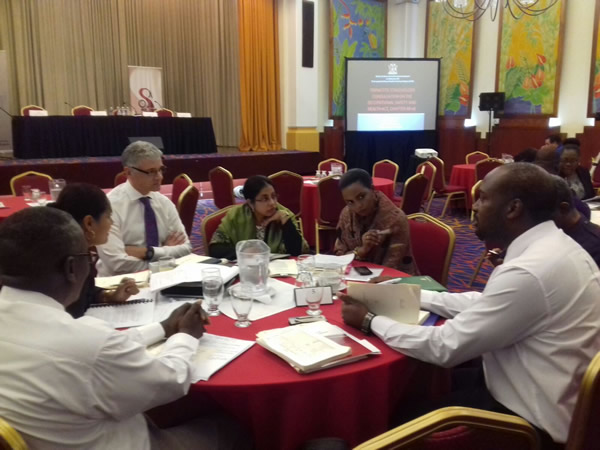
President sitting at far right amongst attendee's
